
A recent decision[1] held by the Court of First Instance of the Unified Patent Court between Dutch start up “Plant-e” and Spanish start up “Arkyne” illustrates the approach taken by the new Court for determining infringement by equivalence.
Background
The claimant Plant-e Knowledge B.V is the proprietor of European Patent EP2137782B1 entitled “Device and Method for Converting Light Energy into Electrical Energy”. The patent relates to Plant-based-Microbial Fuel Cell (“P-MFC”). Generally, MFC have a reactor that needs to be supplied with external fuel and involves large CO2 emissions. The patent aims at solving this problem by incorporating a living plant into the device as a supplier of fuel for the process.
The defendant and alleged infringer Arkyne Technologies S.L. is referred to as “Bioo”. Both Plant-e, and Bioo received grants from the European Union, for R&D in the same area. In 2018, the parties, agreed on a non-exclusive licence for the sale of the Bioo Ed product. In 2019, Bioo terminated the licence agreement and in 2020 filed its own patent application leading to PCT WO2022058500A1, titled ‘Device for producing energy and use thereof’.
Infringement Analysis
The Plant-e patent has two independent claims directed to a device and corresponding method for converting light energy into electrical energy and/or hydrogen comprising a reactor. The Court studied both the validity of the patent and its alleged infringement focussing on the method claim 11 reproduced below:
Method for converting light energy into electrical energy and/or hydrogen, wherein a feedstock is introduced into a device that comprises a reactor, where the reactor comprises an anode compartment (2) and a cathode compartment and wherein the anode compartment comprises a) an anodophilic micro-organism capable of oxidizing an electron donor compound, and b) a living plant (7) or part thereof, capable of converting light energy by means of photosynthesis into the electron donor compound, wherein the microorganism lives around the root (8) zone of the plant or part thereof.
[1] https://www.unified-patent-court.org/sites/default/files/files/api_order/24FDA62A30C8A8D7838D5739CE610873_en.pdf
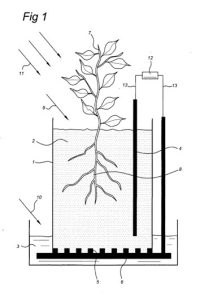
The Court of Appeal of the UPC relied on Art 69 PEC (the protocol) for interpretation of various features of the claims and reinforced that a patent must be interpreted from the point of view of the average person skilled in the art, in this case a person or a team with scientific background (PhD) in biochemistry/ electrochemistry and working in the field of microbial fuel cells.
No Literal Infringement
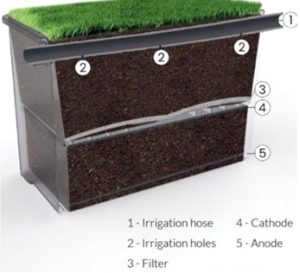
The Court found that the Bioo Panel contained all the features of claim 11, except for the location of the plant and its roots (together with the micro-organisms) in the anode department stating: “In the Bioo Panel the (roots of the) plant are in an upper compartment, whereas the anode (with the micro-organism), and thus the anode compartment, is located at the bottom of the lower compartment.”
Infringement By Equivalence
Is the setup of the Bioo Panel provided with two compartments, (in which the plant with its roots is located in the upper compartment, which is not the anode compartment), equivalent to the method claimed which requires the plant and its roots to be in the anode compartment ?
To answer this question the Court decided to apply the following four point test:
-
Technical equivalence: does the variation solve (essentially) the same problem that the patented invention solves and performs (essentially) the same function in this context ?
-
Is extending the protection of the claim to the equivalent proportionate to a fair protection for the patentee: in view of his contribution to the art and is it obvious to the skilled person from the patent publication how to apply the equivalent element (at the time of infringement) ?
-
Reasonable Legal Certainty for third parties: does the skilled person understand from the patent that the scope of the invention is broader than what is claimed literally ?
-
Is the allegedly infringing product novel and inventive over the prior art? (i.e. no successful Gillette/Formstein defence)
Initially, Bioo argued that the upper and lower compartments of the Bioo Panel are not in contact with each other, hence preventing nutrients /feedstock from the upper part to reach the lower part of the Panel where the anode and cathode are located. After having performed various tests on the Bioo Panel, it was held that the set up of the Bioo Panel was:
” technically equivalent to the teaching of the patent as the plant is part of the reactor and is a source of additional organic material for the battery. The effect of this is that the device is substantially independent of external fuel for the generation of electricity. The plant in the Bioo Panel has the same function as in the claim and solves the same problem. It does this in a similar way, the only difference being an extra compartment which does not affect the function of the plant and is deemed to be equivalent.”
The Court also held that by introducing a plant into the device/reactor to obtain electricity from organic material originating from the photosynthesis by that plant, Plant-e had obtained new category of microbial fuel cells; concluding that a fairly broad scope of protection should be granted. Bioo submitted they came up with the idea of the two compartments to improve on the system of Plant-e (because presence of roots near or in the anode tends to hinder the functioning); however this argument did not change the conclusion of the Court.
On the third point, the Court held that “The teaching of the patent is to add a plant to a an MFC to provide (additional) feedstock to make the MFC independent of externally provided feedstock. The skilled person will understand that the variation of the Bioo Panel is another way to obtain this result in a similar way.”
On the fourth point, it was held that “At the priority date, the Bioo Panel would have been novel and inventive over the prior art because of the introduction of a plant as part of the device as a supplier of additional fuel for the battery/reactor.”
Consequently, the patent was held to be valid and to have been infringed, by equivalence, both directly and indirectly.
Conclusion
This first decision by the UPC on an infringement case by equivalence illustrates the approach taken by the new Court to decide on the extent of patent protection.
It is noted that the test of equivalence is different from the test used in the UK based on the Actavis[1] case. While both tests may well lead to the same conclusion it will be interesting to follow the evolution of the doctrine of equivalence at the UPC as more cases are being heard.
[1] In the UK the doctrine of equivalents is set out in the Actavis case (Actavis v Eli Lilly [2017] UKSC 48. ) by answering the following three questions:
- i) Notwithstanding that it is not within the literal meaning of the relevant claim(s) of the patent, does the variant achieve substantially the same result in substantially the same way as the invention, i.e the inventive concept revealed by the patent?
- ii) Would it be obvious to the person skilled in the art, reading the patent at the priority date, but knowing that the variant achieves substantially the same result as the invention, that it does so in substantially the same way as the invention?
iii) Would such a reader of the patent have concluded that the patentee nonetheless intended that strict compliance with the literal meaning of the relevant claim(s) of the patent was an essential requirement of the invention?”
WHERE INNOVATION THRIVES
We put you in control of your destiny by organising, optimising, & monetising your Intellectual Property.