
When the General Court of the EU handed down its 14 January 2026 judgment in Lego A/S v EUIPO (and intervener Guangdong Qman Toys Industry Co. Ltd), it wasn’t just another skirmish over the shape of a plastic brick, it was a reminder that even the mightiest IP empires occasionally lose a brick in the road. The case revolved around whether Lego’s registered EU design for a toy building block (images below) possessed individual character, or whether it blended too seamlessly into the landscape of earlier designs.
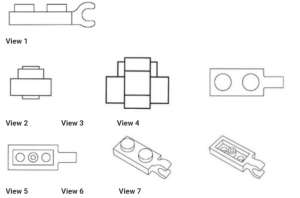
Lego – contested EU Registered Design
The Court upheld the EUIPO Board of Appeal’s decision that Lego’s design lacked individual character because it failed to produce a different overall impression compared to an earlier publication of a similar connector brick, published on a website www.brickset.com (image below).

Earlier publication on www.brickset.com
The Court found that Lego’s claimed distinguishing features weren’t visually impactful enough to sway the “informed user”. In particular, it was found that the main features of the Lego design registration, namely a plate with a cylindrical solid stud on the upper side, smooth surfaces and a crescent-shaped clamp placed at the centre of and perpendicular to one of the outer walls, produced a similar overall impression on the informed user compared to that of the www.brickset.com image. The full decision can be read here.
The Outcome?
Lego’s challenged design remained invalid, and so Lego has lost EU design protection for that particular connector brick. Not a great day in Billund, but Lego has weathered far more complex IP storms and, as will be explored below, its wider IP strategy means that one negative decision does not mean the house of cards (or bricks…) comes tumbling down.
A Wider Lens: Lego’s Sophisticated IP Strategy
To understand why this setback barely dents Lego’s armour, you need to appreciate the depth of the company’s IP playbook. Lego has spent decades transforming IP from a defensive shield into an engine for global brand expansion.
According to a 2025 analysis by The IP Press, Lego’s IP strategy evolved dramatically after its foundational 1958 stud‑and‑tube patent expired in the mid‑1970s. Losing patent exclusivity forced the company to diversify into design rights, trade marks, copyright, brand licensing, and aggressive anti‑copycat enforcement.
Lego’s approach is highly intentional:
- Patents safeguarded the original interlocking brick functionality for 20 years, funded explosive early growth and allowed Lego to dominate the market.
- Design registrations protect aesthetic choices across bricks, minifigures, plates, and accessories.
- Trade marks (including shape marks) protect quality brand reputation worldwide and allowed for co-branded partnerships with major franchises like Star Wars, Harry Potter and Marvel.
- Copyright protects instructions, artworks, packaging, and creative storytelling elements.
This layered strategy isn’t accidental; it’s the architecture of a company determined not to lose its creative monopoly merely because a single patent expires.
Enter: The “Lego Exception” (Modular Systems Exception)
One of Lego’s most powerful allies in EU design law is what the profession affectionately calls the “Lego exception.”
Ordinarily, EU design law excludes protection for features:
- dictated solely by technical function, or
- necessary to allow products to interconnect (“must‑fit” exclusion).
But the modular systems exception makes a vital carve‑out: If a feature serves the purpose of allowing the multiple assembly or connection of mutually interchangeable products within a modular system, it can still be protected.
This exception was tested repeatedly in the Courts, most notably in Case T 537/22 , where the General Court confirmed that Lego’s brick design is protectable under this modularity exception, even when certain features might otherwise fall under “must‑fit” rules.
While this exception has been Lego’s friend in past rulings, it wasn’t enough to save Lego in the most recent 2026 invalidity decision regarding its connector brick, mainly because it cannot rescue a design that simply doesn’t visually distinguish itself from earlier designs.
In other words: The modularity (Lego) exception is a shield, not a magic wand.
Putting It All Together: Why Lego Still Wins the Long Game
The 2026 decision is a reminder that individual character still matters, even within modular systems. A brick that looks too much like an earlier brick will stumble, exception or not.
But in the grander scheme, Lego’s IP foundation remains solid because its IP strength doesn’t depend on a single design registration. From bricks to film universes to video games to theme parks, Lego’s transmedia expansion grows not from chance but from decades of disciplined IP stewardship.
Scintilla is Where Innovation Thrives
We put you in control of your destiny by organising, optimising, & monetising your intellectual property.