
We are now into the month of October and therefore our blog is going to take a bit of a spooky turn.
Did you know that Intellectual property can be used to protect the ghoulish, scary and freaky? If you think about it, the most obvious examples being the copyright protection that horror movies or Stephen King novels receive. However, there have also been several patents granted for inventions that border on the macabre. Today we will be discussing the very spirited invention from 1890 known as the talk board or, more commonly, the Ouija board.
The story of the Ouija board starts at a farmhouse in Hydesville in the state of New York, USA, in the 1840s. Two sisters known as the Margaretta (Maggie) and Kate Fox claimed to be communicating with a spirit through a series of knocks and taps on their bedroom walls. The Fox family left the home, frightened by the soul of the departed which was haunting the farmhouse. The two sisters, Maggie and Kate, were sent to live with their older sister, Leah, in Rochester, New York. Whilst they were now presumably safe away from the ghost, spirit or poltergeist that haunted the farmhouse, the infamy of the story followed them.
Many residents in Rochester found the story fascinating and believed that the spirit was a peddler who had been murdered in the farmhouse a few years prior. They wanted to search the farmhouse for evidence of the murder and hold a séance with the two sisters. This marked the beginning of a mass religious movement centred on communication with those beyond the veil. This movement was Spiritualism.
A seer named Andrew Davis heard about the sisters and invited them to a meeting at his home so that he could bear witness to their psychic abilities. Davis was impressed and the three sisters (Maggie, Kate, and Leah) began a tour to spread the word of Spiritualism.
The movement grew and American citizens took to it. The idea of being able to communicate with those who have passed on was comforting, especially during the 1800s, when lifespans were short, and children died young. During the 1860s, Spiritualism gained even more followers due to the American Civil War, causing people to seek any method possible to communicate with their loved ones who’d gone to fight and never came back.
All this time, the way to communicate with the spirits was long and tedious. One had to call out each letter of the alphabet in turn and wait for the spirit to give a sign or a knock at the right letter. In the late 1880s, there were reports of a new form of communication known as a ‘talking board’. This was a flat board engraved with letters and numbers. A planchette[1] was provided to point to each letter and number as a way of communicating with the spirits.
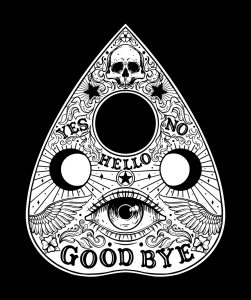
An entrepreneur of the name Charles Kennard read these reports and saw an opportunity. Kennard bought several investors together to found the Kennard Novelty Company who had the aim to make and market the talking board. They named it the ‘Ouija Board’ and to protect their assets and secure their market position they proceeded to file a patent application for the Ouija board.
Now, the founders and attorneys of Kennard Novelty Company knew that to get their patent granted, they would need to prove that it worked[2]. Inventor and lawyer, Elijah Bond, and his sister-in-law (and medium) Helen Peters travelled to Washington D.C. to file their patent application in person at the United States Patent Office (USPTO). The chief patent officer, as expected, demanded that Bond and Peters prove that board works. The officer said that if Bond and Peters used the board to communicate with the other-side and get the spirits to accurately spell out the officer’s name then the patent would be granted. The Ouija board fulfilled this demand and the patent was granted. The original Ouija board patent document can be seen through this link: Ouija Patent – 1891.
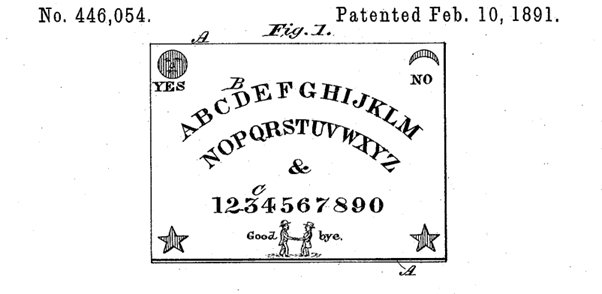
The granted patent (US446054) served its purpose for the Kennard Novelty Company. They made a lot of money and demand was high. The company began with a first manufacturing factory in Baltimore but soon had six factories in the USA and one in London.
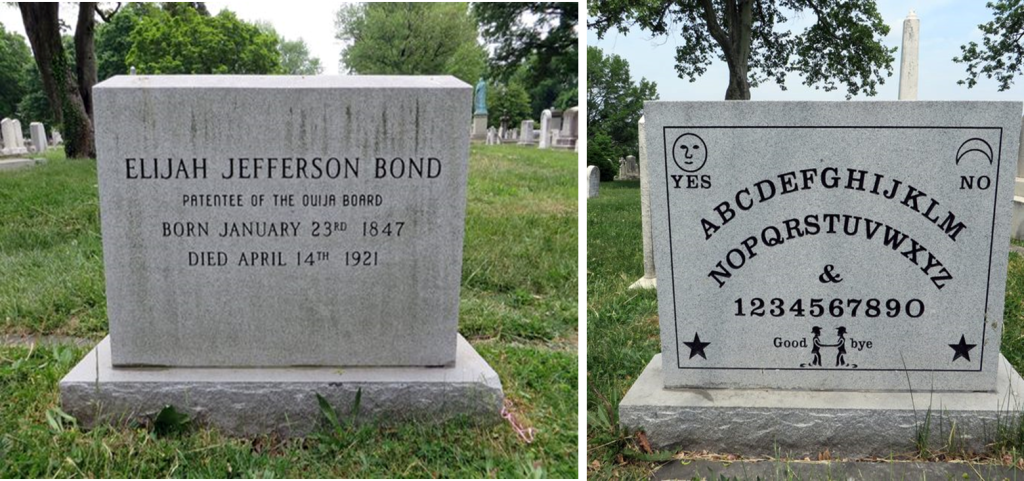
The original patent document itself is written in a mysterious way and was ambiguous as to how the board works. It is very unlikely that a patent application written as such would get granted today in any patent office in the world. However, Bond (and Peters) were able to prove that the board worked which was enough to satisfy the USPTO at the time. Though, was it really the spirits that divined the name of the chief patent officer and spell it out with the planchette? Perhaps. Yet it is also just as likely that Bond duped the officer. Elijah Bond was a lawyer and likely new the officer’s name. However, Bond was very proud of his Ouija patent as is demonstrated by his gravestone (see below).
However, it was not only the USPTO that was deceived. The residents of Hydesville and Rochester in the 1840s who so believed that the Fox sisters were psychics were, unfortunately, mistaken. The Fox sisters tapping communications with an unknown spirit was merely the two of them playing a practical joke on each other and the rest of their family. In 1851, Mrs. Norman Culver, a relative of the Fox family, admitted in a signed statement that she had assisted them during their séances by touching them to indicate when the raps should be made. She also claimed that Kate and Marggie revealed to her that they produced the raps by cracking the bones in their toes and using their knees and ankles. Therefore, the movement that lead to development of the Ouija board, which is now a prominent feature in horror tales and movies scaring teenagers and adults alike, was built on a lie.
Though if there is something to take from this story, it is that the Kennard Novelty Company were able to capitalise on the movement as they correctly identified the importance of intellectual property.
Sources:
[1] https://www.smithsonianmag.com/history/the-fox-sisters-and-the-rap-on-spiritualism-99663697/
[2] https://www.smithsonianmag.com/history/the-strange-and-mysterious-history-of-the-ouija-board-5860627/
[3] https://en.wikipedia.org/wiki/Ouija
[5] https://www.atlasobscura.com/places/elijah-bond-s-ouija-board-grave
[4] The Dollop Podcast – Episode #28 (and sources therein)
[1] If you didn’t know what one was before, a planchette is a small board supported on castors, typically heart-shaped and fitted with a vertical pencil, used for automatic writing and in seances.
[2] Patents must be capable of industrial application to be granted, for example it is not possible to patent a time machine or perpetual motion machine. Well, that is until the laws of physics change 🙂
WHERE INNOVATION THRIVES
We put you in control of your destiny by organising, optimising, & monetising your Intellectual Property.